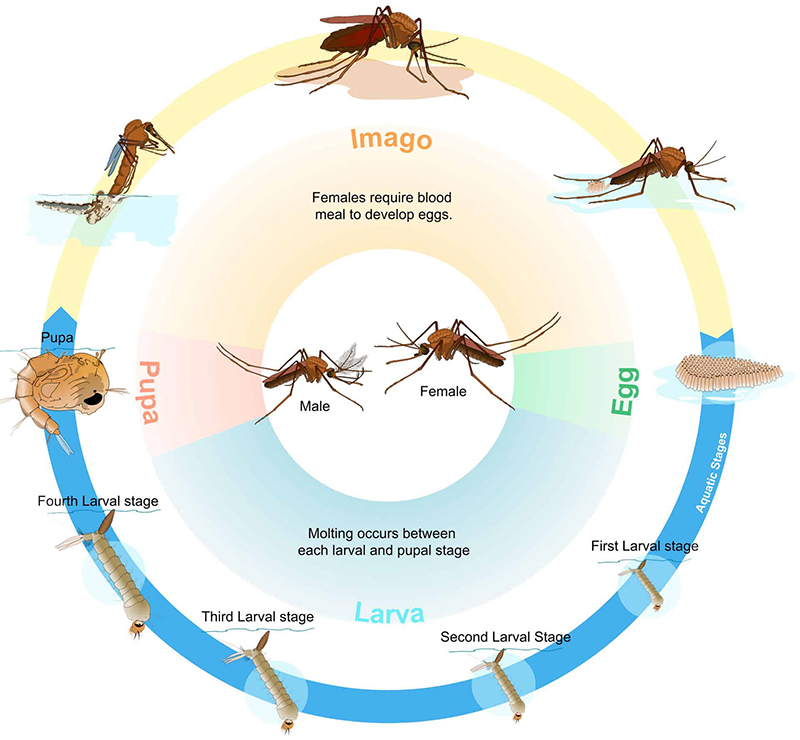
Life cycle consists of egg, larval, pupal, and adult stages. All mosquitoes require water for complete development.
- Egg stage
- Eggs may be laid singly at waterline in soil or in containers, or in rafts on water surface.
- Incubation varies according to habitat, geographic location, amount of daylight, temperature, and species.
- Most eggs hatch into larvae within 48 hours during the peak of summer.
- Eggs laid in the fall may overwinter.
- Eggs laid by some kinds of mosquitos' resist drying out and can remain viable in the dried state for months or years.
- Larval Stage:
- Also called "wigglers".
- Must have water to complete development.
- Stagnant water is ideal.
- 4 developmental stages "larval instars".
- Air tube for breathing called a "siphon" that penetrates the surface of the water.
- Feed on microorganisms and organic debris in water column.
- Some larvae have piercing siphons and attach to the roots of submerged aquatic plants for oxygen.
- Pupal Stage
- Comma-shaped body also called "tumblers".
- Stage only lasts a few days.
- Pupae do not feed.
- Air tube for breathing called a "trumpet" that penetrates the surface of the water.
- Adult "Imago" Stage:
- Newly emerged adults rest on the water surface while wings dry and harden.
- Average adult lives from 2 to 3 weeks, over-wintering adults live 6 to 8 months.
- Only females search for a blood meal.
- Many mosquitoes stay very close to their breeding site.
- Blood meal is used for egg development.
- First batch of eggs in spring may be produced autogenously (without a blood meal).
- Males live only long enough to breed and do not feed on blood.
- Females can lay as many as 200 eggs with each blood meal and can have many blood meals in her lifetime.